They are all children
Reclaiming the birthright of childlikeness

“The most sophisticated people I know — inside they are all children.” ~Jim Henson
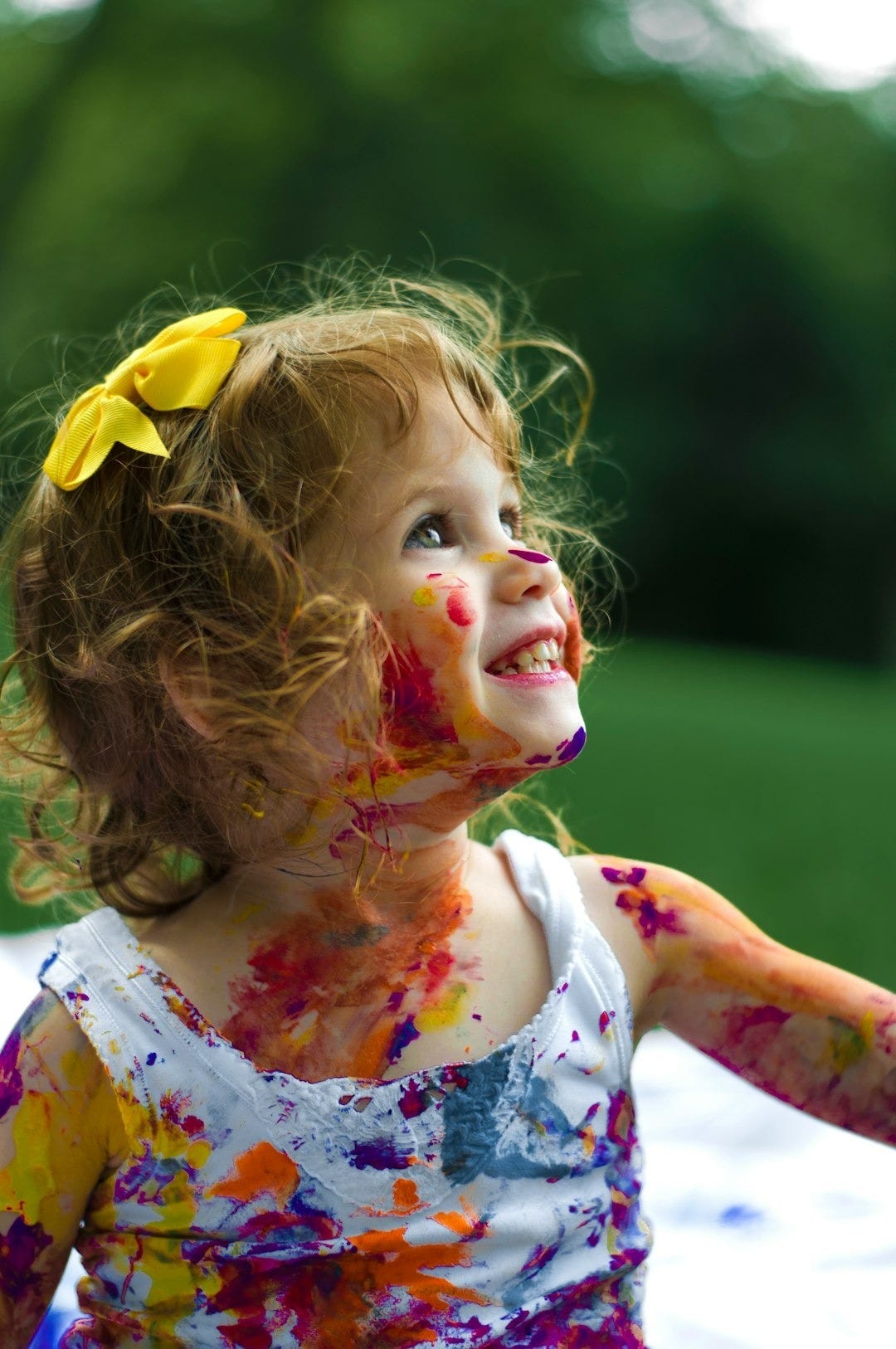
“…unless you change and become like little children, you will never enter the kingdom of heaven.” ~Matthew 18:3, NIV
What does it mean that many of us have lost touch with the birthright of childlikeness? Childlikeness is marked by curiosity, wonder, unselfconscious authenticity, laughter and delight, an ease of loving and receiving love, guilelessness and trust. It involves being fully and unapologetically who we are, without second-guessing, without holding back, without guardedness. It means being imaginative and creative, open-hearted and accepting. Who wouldn’t want to remain childlike when you consider these joyful, expansive and carefree attributes? So why we do we turn from these so early, and why do so many of us look distrustfully and even mockingly at some of these characteristics in adults?
For certain, the vulnerability scares many of us. We lose the ease of trusting and loving others freely and big-heartedly after a few sharp hurts and rejections. In order to avoid the discomfort of mourning the loss of our innocence, we instead look askance at it, we come to distrust our innately trusting natures and to see ourselves as wiser for having learned that fewer people can be trusted than we thought, and fewer people deserve our unreserved love; only a small number are safe people to see and know our truest selves. It feels better to become hardened and cynical, to feel superior to that old, aching young self, open to all the jokes and jabs the world puts out there. We quickly learn that since we no longer desire to walk around like an open wound, ready for re-wounding, we might as well fit in with other jaded, self-conserving peers.
We start risking less: socially, creatively, at school, at play, at home, and eventually at work. When we do risk, it’s easy to second guess and to berate ourselves when things don’t go perfectly to plan. “You shouldn’t have put yourself out there like that,” we chide ourselves. “Stupid! That was stupid. Don’t do that again.” It carries social clout to look unimpressed and unaffected by most things. Yet, how I love that Jim Henson, (that visionary bridger of the adult/child divide), observed that even the most sophisticated people he knew were all children inside. Indeed, our very self-protective snark and sneering countenance is an indication that we are trying to guard our inner child from loving too much, opening to the world too much, giving too much, risking too much. The sophistication is often a shield.
The world for certain can be cruel. Many of us could elucidate a multitude of personal anecdotes that illustrate this before even zooming the lens outwards to the horrors and atrocities beyond our own experiences. So why would we want to reclaim elements of a simple childlikeness, knowing what we know, and how can we possibly do so as busy, responsible, burdened adults?
Creativity is the work of an inner child. Without imagination, without any sense of in-touchness with a world that is somehow bigger, brighter, more technicolor, more unusual or magical or even just other than it appears, we struggle to create anything. To create we have to “dwell,” like Emily Dickinson, “in possibility.” That means we have to imagine another way, to approach things in unique, inquisitive, sometimes even outrageously bold ways. The more “adult” we become, the harder it is to open ourselves to this raw creative self.
To be in awe in the world, looking as if for the first time upon its beauty and mysteries, its complexities and intricacies, is to know joy: not just happiness, ephemeral and on the surface, but deep and satisfying joy. Children who have not yet known tragedy and the world’s abuses have access to this kind of novice wonder and effortless joy as though it is just in the ether of their existence, part of the air in which they “live, move, and have their being.” The more time you spend with children, not so much in a supervisory role, but in a participatory, engaged, dig in the dirt, throw on the dress-up clothes, play hide-and-seek form, the more enchanting the world will feel. The more you will find yourself caught up in the moment, swept into a flow state, grinning, cackling with your head thrown back, maybe even shrieking, and you’ll recognize it as joy.
So how do we reconnect with this birthright? How can we still, despite a wearying and disaffected world, access the child in each of us?
Spend time with children. They need not be yours. Volunteer to babysit a niece or nephew, a couple of cousins, or call up a young family, and be elevated to near saint status when you offer your babysitting services unexpectedly to a mom or dad who has been barely hanging on.
Celebrate holidays to the fullest, preferably minus the booze. Children do not need booze to enjoy a holiday. The incorporation of booze can cause all holidays to blur into one, more or less, and we lose the full-firing of our senses, the sensory ignition that used to make special days and holidays sparkle for us as children.
Take the time to decorate enthusiastically for holidays, invite others to join you for celebrations throughout the year, and practice seasonal rituals. Children love to color coloring pages for the seasons, to create holiday crafts, to mark the time with traditions and rituals. Just try forgetting a tradition one year, and a child will let you know in no uncertain terms that the seemingly insignificant ritual is nonnegotiable. The more we incorporate traditions, rituals, and the marking of seasons with celebrations into our lives as adults, whether we have children or not, the more we bring some of that childlike exuberance into our grown up experiences year round. We also invite others to join us, and by doing so, we give our friends and family the gift of reconnecting with their childlike selves. They become once again the little kid who jumped with glee when mom filled a crystal candy bowl with candy-corns at Halloween or the sticky-faced toddler licking a rocket pop on Independence Day, tongue blue, lips cherry red, eyes bright. Why not buy yourself a rocket pop this summer, and savor the nostalgia? Don’t apologize for your blueness, redness, or stickiness. Share a pack of rocket pops with stuffy growns up nearby. Watch their demeanors transform.
Write “morning pages.” This practice, of course, comes from the marvelous Julia Cameron, artist, guide, teacher, and author of the seminal toolbook and manifesto, The Artist’s Way, and countless other books on creative unblocking. If you’re not familiar with morning pages, completing them is simple. As soon as possible upon waking, write three pages of long-hand in a notebook. Writing these by hand is important. Do not censor your writing or edit it. Do not write as though anyone else will see it. It is only for you. Write free-flow, without second-guessing or wondering if what you are writing is good. This practice, when used daily, blocks gummed up creative channels and opens access to our childlike selves. The dirt and debris of this world begin to get unstuck from our inner pipelines, and we find ourselves better able to access our imagination, better able to access hope.
Take “artist dates.” This is another vital piece of wisdom from Julia Cameron. An artist date involves taking yourself off once a week (or at least every other week) for a solo expedition meant to feed your inner artist (your child self). Cameron insists that these should be taken without family or friends in tow, and you should choose a destination that delights, inspires, and/or enchants you. Look for someplace whimsical, beautiful, artistic, aspirational. It could be a trip to a local artist supply store to pick out a new artistic tool or simply to browse and exclaim over the variety, the colors, the potential. An artist date might be a quick trip to a local museum, historic site or a tour of an author or artist’s home. It might be as cheap and simple as a picnic on a blanket along a river or as extraordinary and glamours as a Broadway show complete with a three-course dinner beforehand. As Cameron explains “it matters less where you take them than that you take them.”
At least occasionally say “yes” to spontaneity. Children don’t plan everything out. They live in the moment, and if an unexpected invitation to play arises, they take it. I’m the worst at this. I struggle with spontaneity, but I do recognize that a life planned every moment, with no wiggle room, is a life less open to accidental, carefree joys.
Read children’s books! I love fairy tales and classics like The Secret Garden, Anne of Green Gables, Little Women, Tuck Everlasting, My Side of the Mountain, but I am equally grateful for and swept away by contemporary, diverse picture books and children’s novels. Stories told through the eyes of children are a fast track back to our childhood and/or a foray into a different childhood.
Read Isabel Allende, Gabriel Garcia Marquez, Alice Hoffman, Arundhati Roy, Salman Rushdie: any author who writes with luscious, sensuous magical realism. Magical realism treats the magical as though it is to be expected, as though it is part of everyday life, much the way every day life is “enmagicked” for young children. Don’t you love this term, “enmagicked,” coined by Kelly Barnhill in The Girl Who Drank the Moon?
Looking for further guides on your journey towards reclaiming your birthright of childlikeness?
Here are some of my favorites:
Walt Whitman: Whimsical proponent of the mindset: “Dismiss whatever insults your own soul.” If only we had been practicing that mantra since birth.
Maria Popova: Secular high priestess of awe, wonder, curiosity, exploration.
Louisa May Alcott: She created Jo March, after all, and in some respects was Jo March.
Henry David Thoreau: Master of maintaining a “beginner’s mind” when studying nature.
Madeleine L’Engle: Read her Walking on Water: Reflection on Faith and Art.
Dylan Thomas: Have you read A Child’s Christmas in Wales?
Ross Gay: The Book of Delights; say no more
Virginia Woolf: Please read The Waves. It’s experimental. It pops into the minds of six children who experience the world in electrically vivid snapshots and jolts of sensory-rich imagery
Georgia O’Keefe paintings: Generally only a child has the time to study a flower the way O’Keefe explores the inside of a single bloom. A child can lounge in the grass, a leg crossed at a bent, skinned-up knee, looking into a single blossom with no hurry. O’Keefe helps all of us see the geometry and elegance of a single flower as though for the very first time.
Artists everywhere. Look especially for colorful, vibrant, art and unusual, playful perspectives.
Poets everywhere. Poets excel at attention. As we age, we tend to lose patience with attention, so poets can show the way back to a slowed down, childlike attentiveness.
What are some of your favorite ways of keeping connected to this birthright?
Who are some of your favorite guides?

\